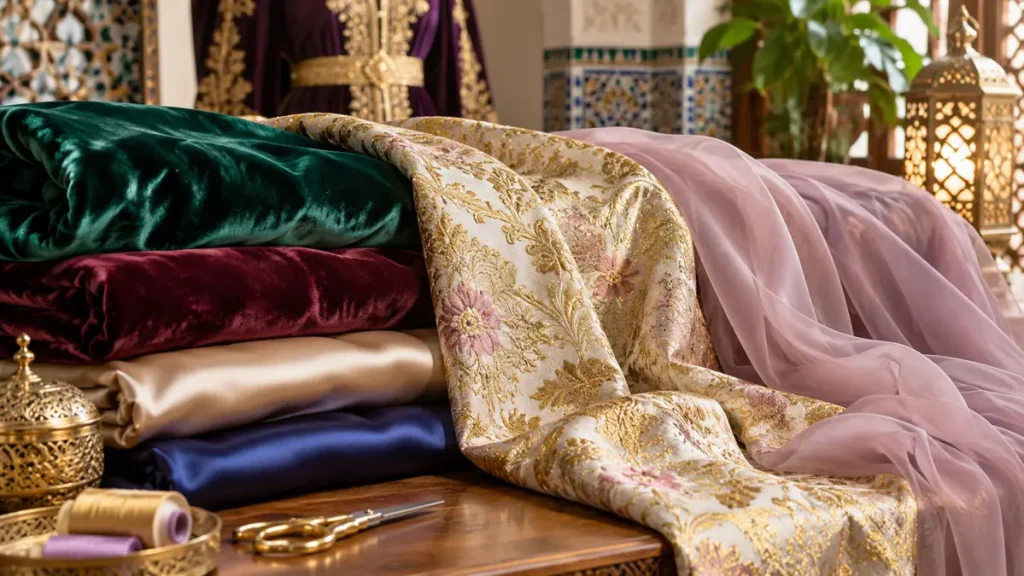
Choosing a Moroccan caftan fabric is not only about selecting a colour you love. The textile determines how the garment moves, how much embroidery it can support, how warm it feels and how easily it can be altered.
Fabric names used by shops can be broad, and fibre content is not always obvious from a photograph. This guide focuses on practical behaviour so you can evaluate a description more confidently.
Start with four useful questions
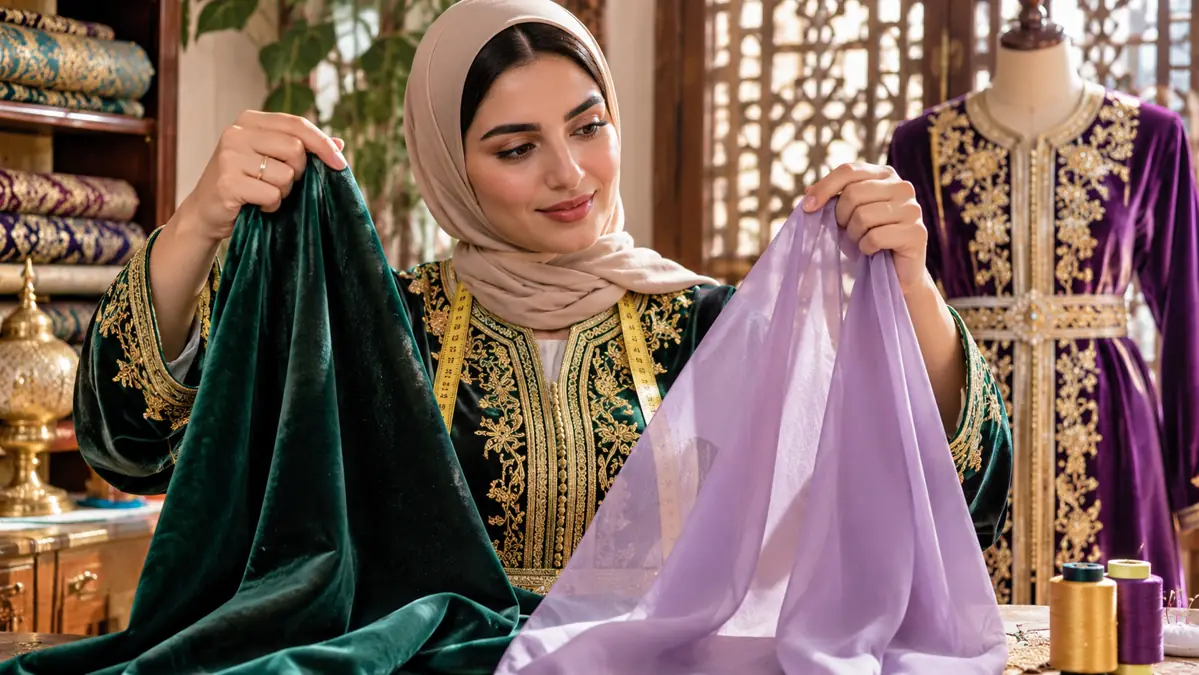
Ask how the fabric drapes, how much it weighs, whether it is transparent and how its surface reacts to decoration. Those four characteristics affect comfort and appearance more directly than a glamorous fabric name.
Also consider the event. A fabric that looks impressive in a studio photograph may feel too warm for an outdoor summer celebration or too delicate for a long, crowded evening.
Velvet: depth and ceremony
Velvet absorbs light and gives deep colours a rich appearance. It can support substantial embroidery and often suits cool-weather weddings, evening events and formal interiors.
Its advantages come with weight and warmth. Dense velvet combined with lining, embroidery and a heavy belt can become demanding over several hours. Check the season and venue before choosing it simply because the colour looks luxurious.
Satin: light-catching and fluid
Satin describes a weave and surface character rather than one fibre. Its smooth face reflects light, giving a caftan a polished, fluid look.
Because the surface reveals creases, pulling and some seam imperfections, cutting and fit matter. Very shiny satin can dominate photographs, while a softer finish is often easier to combine with detailed embroidery.
Brocade and jacquard: pattern within the cloth
Brocade and jacquard fabrics carry woven motifs, so the textile itself provides decoration before sfifa or embroidery is added. They can create structure and visual richness with less applied ornament.
The challenge is balance. A large woven pattern, dense embroidery and a statement belt can compete. A restrained decorative plan often allows the woven design to remain visible.
Chiffon and other sheer fabrics
Chiffon is light and mobile, making it useful for flowing sleeves, overlays and warm-weather designs. It usually requires an opaque underlayer where coverage is needed.
Its delicate nature means snagging and seam finishing deserve attention. A light fabric is not automatically simple to make: controlling transparency and movement can require careful construction.
Silk and silk blends
Silk can offer beautiful drape, temperature comfort and subtle lustre, but the word is frequently used loosely in retail descriptions. Ask for fibre composition rather than assuming that “silky” means natural silk.
Blends may be practical. They can improve crease resistance, control cost or add stability. What matters is honest labelling and whether the resulting fabric suits the intended design.
Crepe: controlled movement
Crepe fabrics often have a slightly textured surface and a drape that feels less reflective than satin. They can work well where the cut and embroidery should be noticed without a highly glossy background.
Different crepes vary widely in thickness and fibre, so the name alone is not enough. Ask whether the fabric is lightweight, opaque and stretchy.
Matching decoration to fabric
Heavy embroidery needs a base with enough stability to carry it without sagging. Delicate textiles may require backing or lighter motifs. Raised beading can change the way a sleeve hangs and make folded storage more complicated.
Look at decoration and fabric as one system. A beautiful motif is not successful if it distorts the cloth or makes the garment uncomfortable.
Buying from photographs
Use close-up photographs to examine texture, not just colour. Video can reveal drape better than a still image. Ask how the fabric feels, whether it is lined and whether the listing states fibre content.
Colour can shift between screens and lighting conditions. When exact matching matters, a fabric sample or clear daylight photograph is more useful than an edited studio image.
Final Thoughts
The best caftan fabric is the one that supports the design and the occasion. Velvet offers depth, satin brings fluid shine, woven fabrics contribute pattern, and sheer textiles create movement.
Compare weight, drape, opacity and fibre information before deciding. Those details help you choose a caftan that remains beautiful after the first photograph and comfortable throughout the event.