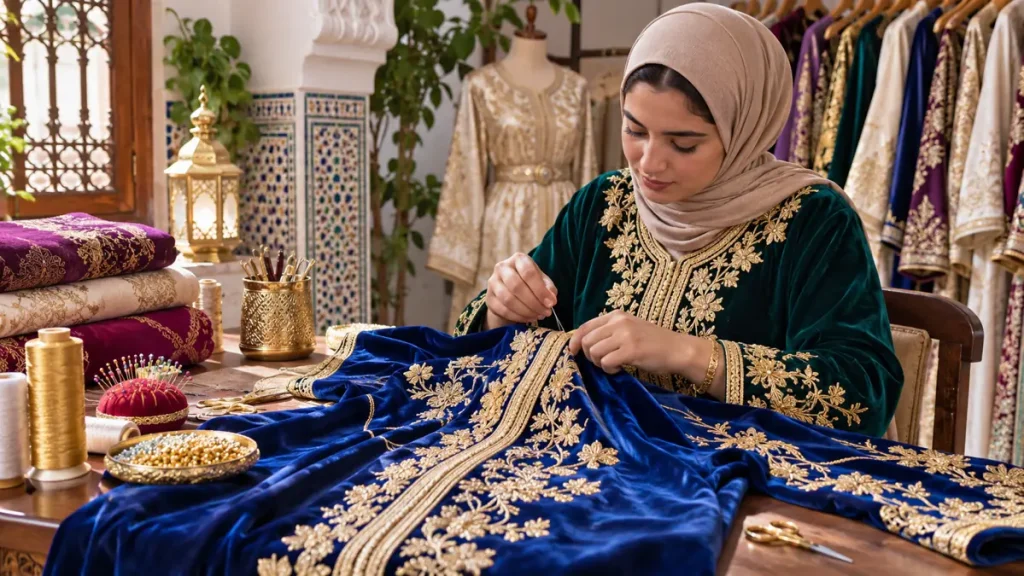
A finished Moroccan caftan can look effortless, but its clean line depends on a sequence of decisions made long before the final belt is fastened. Fabric, cut, decorative placement and finishing must work together.
Methods vary between ateliers and regions, and some makers combine handwork with machine-assisted steps. The following journey explains the main stages without pretending that every workshop follows one identical recipe.
The design begins with the occasion
Before fabric is cut, the maker needs to understand how the caftan will be used. A wedding design may call for a strong visual presence, while a family celebration or formal dinner may benefit from lighter decoration and easier movement.
The desired silhouette, sleeve width, neckline and belt all influence the pattern. Decoration is planned at this stage because embroidery placed without regard to seams or body proportions can make later fitting difficult.
Choosing fabric for structure and movement
Fabric is not simply a colour choice. Velvet holds embroidery differently from satin; chiffon creates movement but needs thoughtful layering; brocade already carries a visual pattern and can become crowded when combined with dense ornament.
A skilled maker considers drape, weight, transparency and how the surface behaves under stitching. Our guide to Moroccan caftan fabrics explains why two fabrics in the same colour can produce very different garments.
Measurements and pattern preparation
Accurate bust, waist, hip, sleeve and length measurements establish the working proportions. Ease must be added so the wearer can sit, walk and raise her arms comfortably.
The pattern is then adapted to the chosen silhouette. A caftan may look straight when hanging, yet small adjustments through the shoulders, side seams and sleeve attachment determine whether it falls gracefully on a real body. See our measurement guide for the measurements most often compared before ordering.
Cutting requires a plan
Pattern pieces are positioned with attention to grain, fabric motifs and symmetry. On patterned textiles, careless placement can cause the left and right sides to look unrelated.
Embroidered panels or decorative borders also need enough space. Once an expensive fabric is cut, major corrections may be impossible, so experienced cutters verify lengths and matching points before committing.
Building the garment
The principal pieces are joined and the basic caftan begins to take shape. At this stage the maker checks the shoulder line, sleeve position, side seams and overall length.
A preliminary fitting can reveal issues that flat measurements do not show. The goal is not to make the garment tight, but to balance a flowing silhouette with enough control that it does not overwhelm the wearer.
Adding sfifa and aakad
Sfifa outlines important edges such as the front opening, neckline and cuffs. Aakad, the decorative loop-and-knot closures, add rhythm and identity to the centre front.
These elements must be applied evenly. Small variations become noticeable because the eye follows the line from neckline to hem. Read our detailed explanation of sfifa, aakad and tarz to understand how each element contributes.
Embroidery and surface decoration
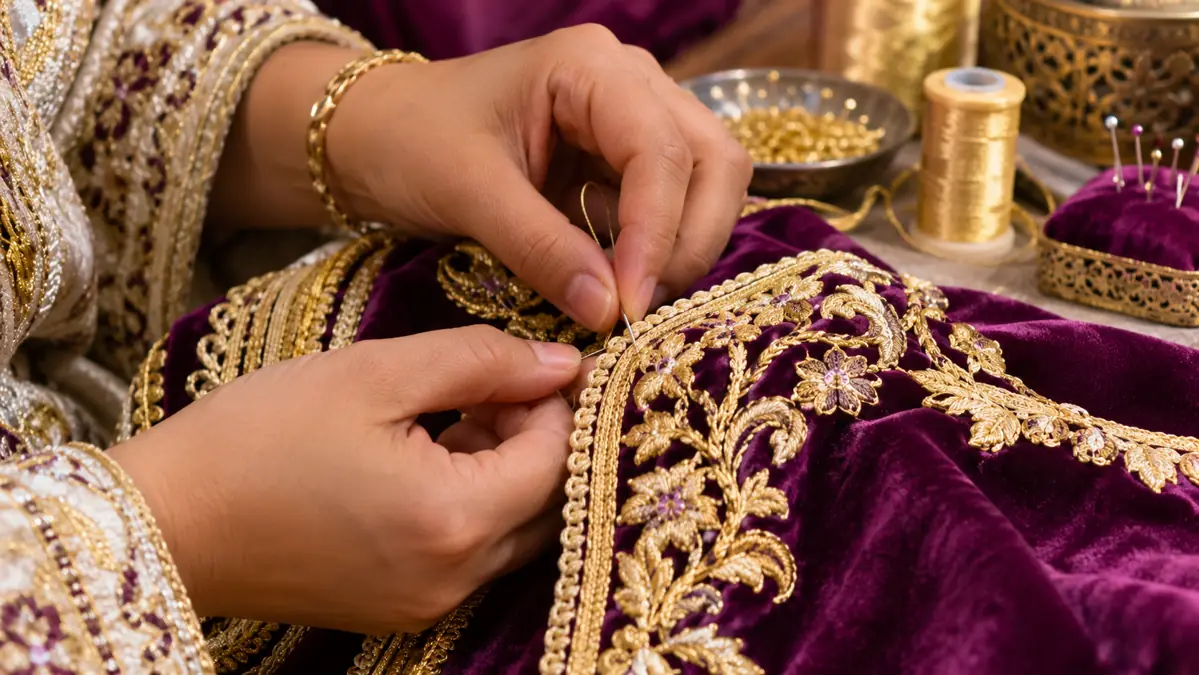
Embroidery may be planned as borders, scattered motifs or structured panels. Its scale should relate to the wearer and the fabric. Dense work can create a magnificent focal point, but it also adds stiffness and weight.
Some decoration is completed before assembly and some after the basic garment is formed. The sequence depends on access, motif placement and the risk of damaging completed work during sewing.
The final fitting and finishing
At the final fitting, the maker evaluates hem length, sleeve movement, closure alignment and the way the belt sits. Loose threads are secured, seams are inspected and pressing is carried out with care around raised decoration.
Good finishing is often quiet. It appears in a straight front line, balanced motifs, clean edges and a caftan that feels composed when the wearer moves.
Final Thoughts
A Moroccan caftan is not created by decoration alone. Its quality comes from coordination: fabric appropriate to the design, a considered pattern, accurate cutting, controlled ornament and careful finishing.
Understanding this process makes it easier to evaluate a product description and to ask useful questions before buying. It also explains why apparently similar caftans can differ greatly in comfort, durability and price.