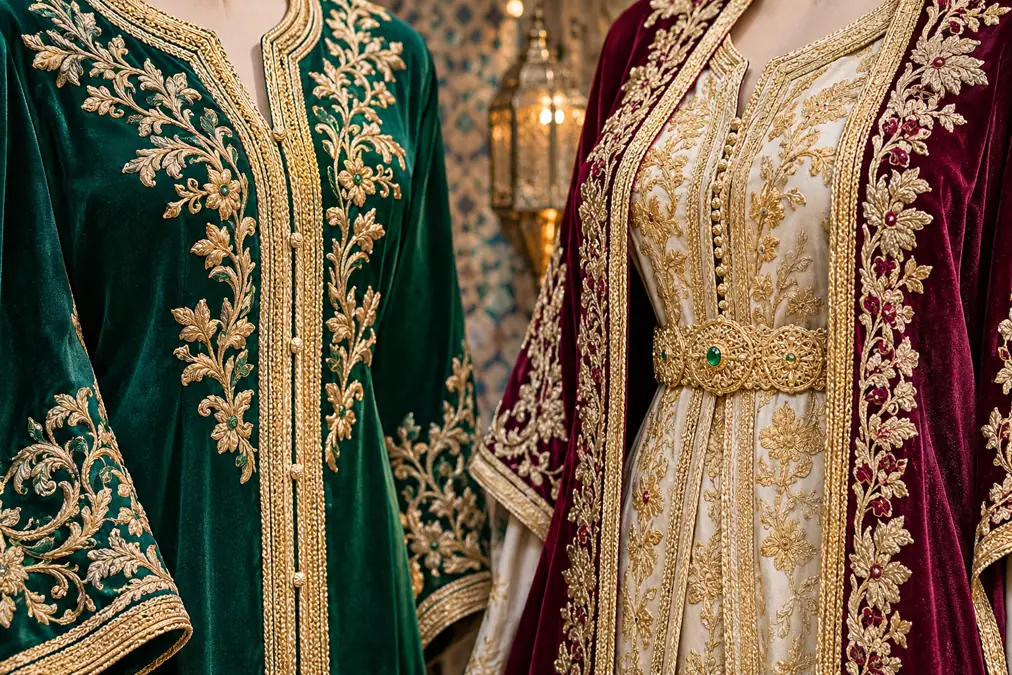
A Moroccan caftan is often recognized through the language of its details. Three terms appear repeatedly: sfifa, aakad and tarz. They describe different decorative functions, although they are designed to work together.
Understanding them helps you read a caftan more accurately. Instead of seeing only gold decoration, you begin to notice the line that frames the garment, the closures that animate its centre and the motifs that build its visual story.
What is sfifa?
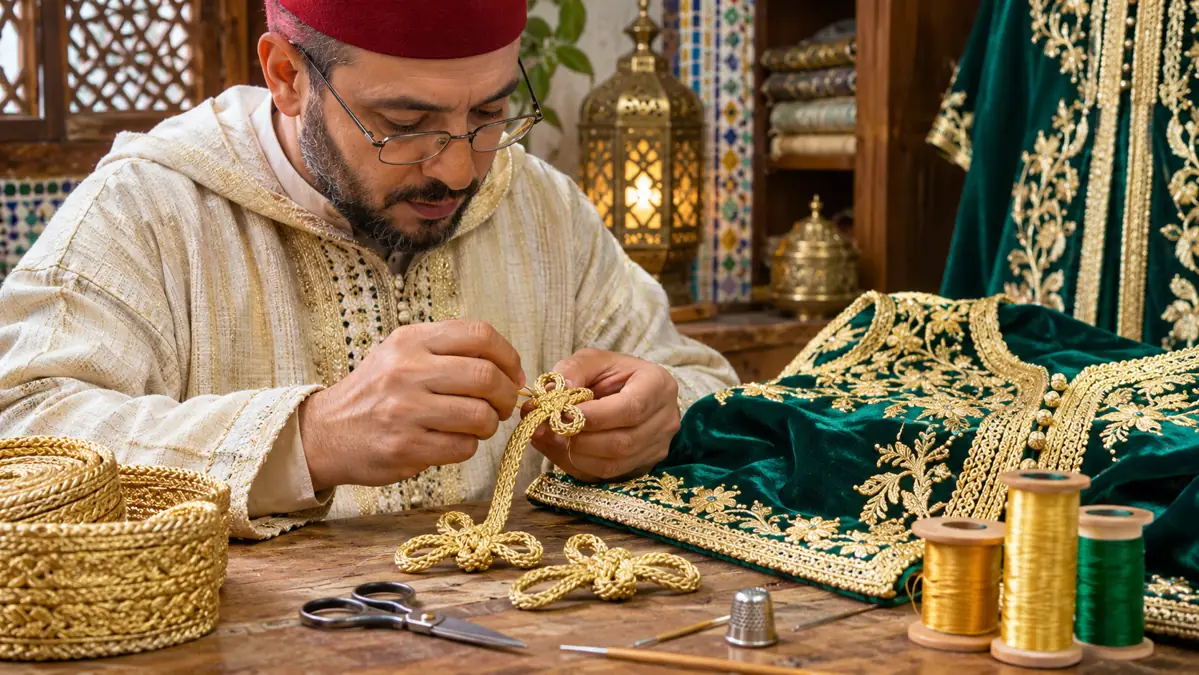
Sfifa is a decorative braided trim used to define edges and important lines. It commonly follows the neckline, front opening, cuffs and sometimes the hem.
Its role is both visual and structural. A clean line organizes the garment and draws the eye vertically. When applied unevenly, the front can appear twisted even if the underlying cut is correct.
What are aakad?
Aakad are traditional knotted closures, often arranged in a sequence along the front. They can be functional, decorative or both, depending on the design.
Their spacing matters. Regular aakad create rhythm and reinforce the centre line. Oversized knots may be intentional, but they should still look controlled and secure.
What does tarz mean?
Tarz refers broadly to embroidery. Moroccan embroidery includes different regional and workshop traditions, so the word does not identify one universal stitch.
On a caftan, tarz may frame the neckline, extend down the front, form borders at the cuffs or create large motifs across the garment. Placement affects proportion as much as decoration.
How the three elements work together
Sfifa establishes direction, aakad articulate the closure, and tarz adds imagery and surface interest. A successful composition gives each element space to be understood.
Dense embroidery around the neckline may be paired with simpler sfifa below it. If every element has equal visual weight, the garment can lose its focal point.
Symmetry and deliberate variation
Formal caftans frequently use strong symmetry because the front opening creates a natural axis. Compare left and right motifs, spacing around the neckline and the way borders meet at corners.
Small variation can reveal handwork. The key is whether the composition remains balanced. Contemporary asymmetry should look intentional rather than accidental.
Colour and metallic thread
Gold and silver tones are common, yet contrast needs control. Warm gold on emerald, burgundy or black can feel ceremonial; tone-on-tone sfifa produces a quieter effect.
Metallic thread behaves differently under direct light. Review both close-up and full-length images because a detail that looks subtle in shade may dominate under event lighting.
Useful questions before purchasing
Ask whether the closures are functional, whether spare aakad are available and whether the embroidery contains beads or sequins that require special care. Confirm what technique was used rather than relying on a broad handmade label.
The objective is to understand the workmanship, maintenance and price of the specific garment, not to rank every method with one simple word.
Looking closely at finish
Check whether sfifa lies flat around curves, whether aakad are securely attached and whether embroidery ends are clean. Loose threads in a close-up image deserve clarification.
Inspect the lining when available. Beautiful surface work should not create roughness against the body or leave threads that catch during wear.
Final Thoughts
Sfifa, aakad and tarz are not interchangeable decorations. Sfifa frames, aakad close and punctuate, and tarz develops embroidered motifs.
Once you identify those roles, comparing caftans becomes more meaningful. You can judge balance, placement and finish instead of relying only on the amount of shine.