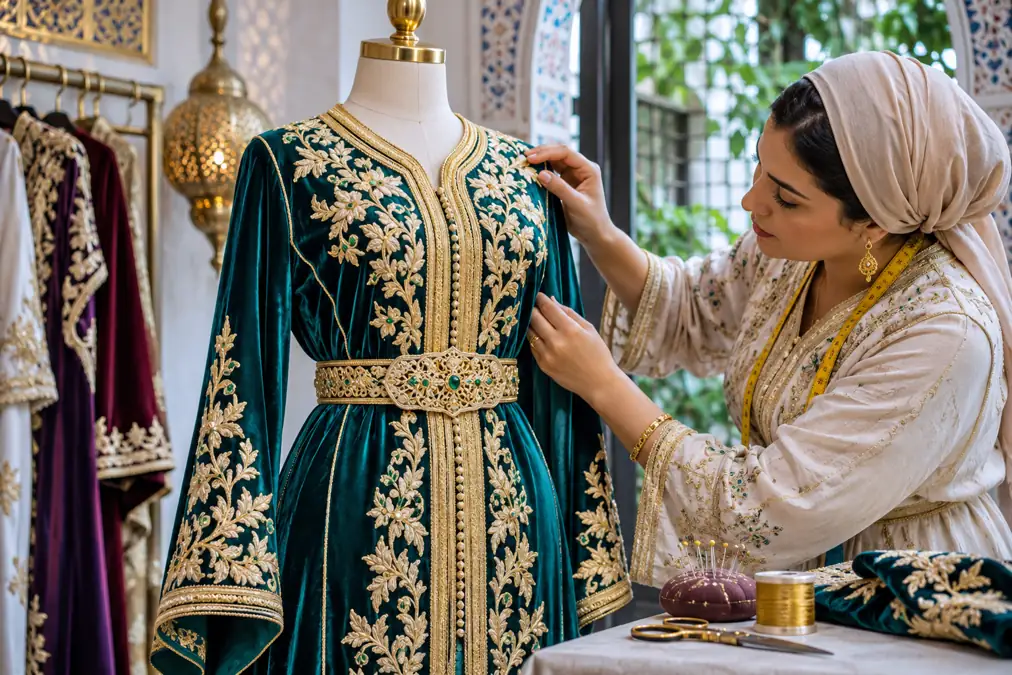
A well-made Moroccan caftan is not necessarily the one with the most embroidery or the highest price. Quality appears in how the garment is planned, assembled and finished.
Some signs can be evaluated in person; others can be checked through detailed photographs and direct questions. The aim is to distinguish character from avoidable construction problems.
Begin with the overall line
Step back before studying the embroidery. The front should hang cleanly, the shoulders should appear balanced and the hem should not twist. A belt can shape volume, but it should not hide a distorted cut.
In photographs, compare the garment from front, side and back. One carefully posed image cannot show how the caftan falls during movement.
Examine pattern placement
When fabric has woven motifs, check whether important patterns are aligned at the centre and balanced across both sides. Perfect matching may not be possible everywhere, but prominent areas should look considered.
Embroidery should relate to the cut. Motifs that disappear into seams or end abruptly at different heights can signal that decoration and construction were planned separately.
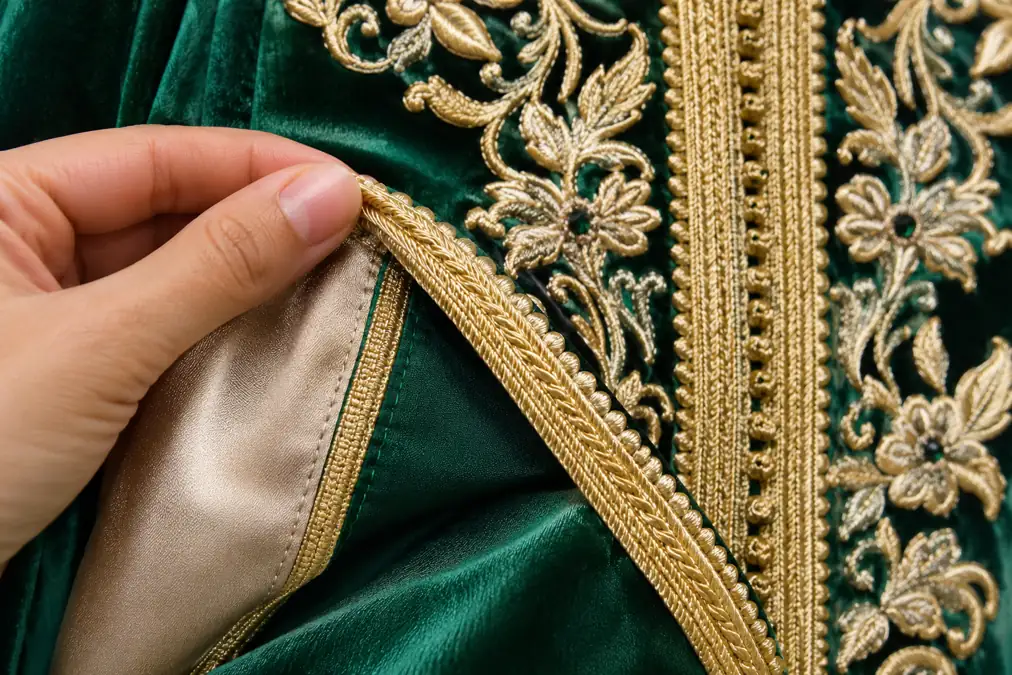
Look closely at sfifa and closures
Sfifa should follow the neckline and front opening without rippling. Aakad should be regularly spaced and firmly secured. Test closures gently rather than pulling them by the decorative knot.
Minor variation can reflect handwork. What matters is whether the sequence remains visually consistent and functional.
Check the seams and interior
Straight, secure seams and tidy finishing reduce fraying and improve comfort. A lining should sit inside the garment without pulling the outer fabric or extending below the hem.
If the interior is not shown, ask for a photograph. It often reveals more about construction discipline than the decorated surface.
Consider embroidery density and support
Dense embroidery adds weight. The base fabric should support it without sagging, puckering or stretching. Around sleeves and necklines, excessive stiffness can affect movement.
Quality is not measured by density alone. A lighter, precisely placed design may be better executed than a crowded surface with uneven tension.
Evaluate fit information
A useful product page provides measurements or a size chart, not only generic labels. Compare your measurements with our caftan measurement guide.
Look for garment length, bust, waist or hip guidance and notes about fit. Clear information does not guarantee perfect sizing, but its absence transfers unnecessary risk to the buyer.
Read material claims carefully
Descriptions such as luxury fabric or premium embroidery are opinions, not specifications. Fibre composition, lining, included accessories and care instructions are more useful.
If a product is described as handmade, ask which parts are made by hand. Specific detail builds more trust than a broad label applied to the whole garment.
Check consistency across photographs
Colour should remain reasonably consistent across images, allowing for lighting. Hardware, belt design and embroidery should match from one view to another.
If images appear to show different versions, confirm exactly which piece will be sent, especially when a listing offers several colourways.
Assess the seller as well as the garment
Clear shipping times, return conditions and reachable contact information are part of a quality purchase. Review the shipping policy and returns policy before ordering.
A trustworthy seller should clarify fabric, size and included pieces without pressuring you to decide immediately.
Final Thoughts
Quality becomes easier to recognize when you separate decoration from construction. Look at line, symmetry, seams, support, closures and the clarity of the product information.
A caftan should be beautiful when viewed closely, but it should also hang properly, move comfortably and arrive as described.